Temple Emanu-El’s Rabbi Friedman ‘radiates warmth and a genuine love for people’
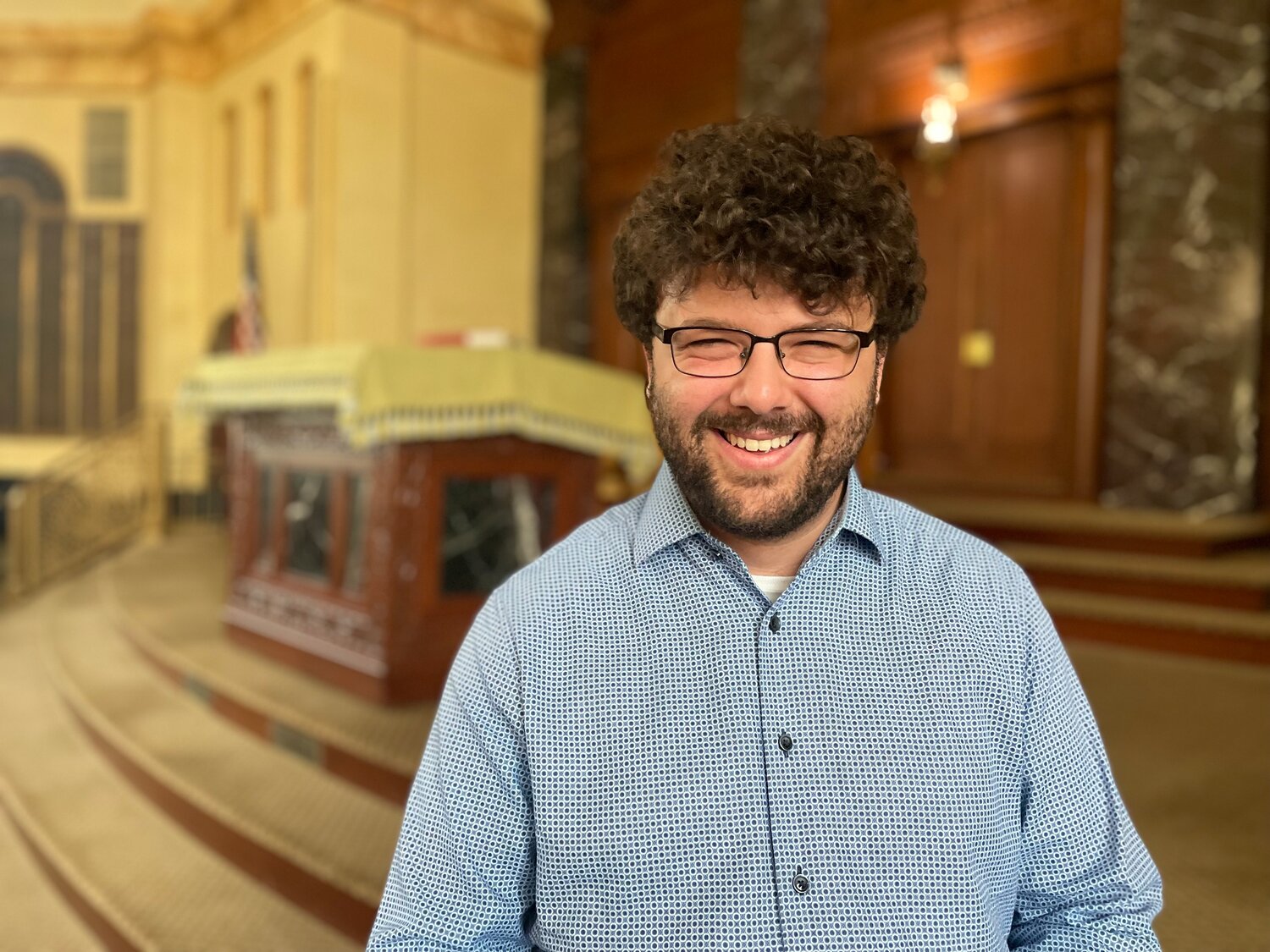
At 28, Rabbi Alex Friedman brings a passion for Jewish tradition, music and community to Temple Emanu-El in Providence. Raised in Austin, Texas, and trained at the Jewish Theological Seminary, Friedman is committed to expanding educational opportunities and helping people find meaning through Torah study in an increasingly complex world.
“I think that we are experiencing a crisis of meaning. I think that we are having a hard time as a society dealing with senses of scale and of right and wrong. I think that we are having a crisis of communication, of learning to talk to each other about difficult things. I think that many of us feel unmoored historically; we think that we're the only ones who've ever felt this way. And I think that studying Torah in community with other people having conversations that are difficult, not in the sense of harmful or hurtful, but just difficult, because they're about things that matter. I think it is a skill that Torah requires us to build, and I think it allows us to build solidarity between the past and the present and think of our lives more in context.”
Though he grew up in “not a particularly observant family” he attended religious school from pre-K through high school and as a kid prided himself on his perfect attendance record. His rabbi, who was originally a cantor, Rabbi Neil Blumoff, had an enormous influence on Friedman. It was really his time in USY when he, “fell in love with being Jewish and doing Jewish with Jews, and didn't see another way to be in the world. I just wanted to do that. I had a lot of Jewish pride before then, then I started developing more Jewish practice.”
Friedman describes Jewish pride as attending shul on the High Holy Days, feeling bad about eating pork, feeling solidarity with Jews around the world. “You know, my parents might use the phrase like, ‘A nice Jewish boy.’ So that's Jewish pride.”
Jewish practice to Friedman means attending shul more often than once a year, showing up to programming around a synagogue, caring about “tzedakah”, learning some Hebrew and engaging in more mitzvot. “There's nothing wrong with either approach. It's just there. I started with one and continued with the other.”
One of the things Friedman returned to was his love of the musicality of Jewish services. “I'm also deeply moved by what I like to call the sonic memory of the Jewish people, which is, if you walk into shul on Kol Nidre, and somebody came up and sang Kol Nidre to the tune of the happy birthday song, it would not feel like Yom Kippur, right? It doesn't work. There's magic in it, right? There's this really sacred beauty to it that requires the music to be taken seriously.”
As a child Friedman remembers seeing his then-cantor’s face in the newspaper, mid-song. He knew, even if he didn’t know what the words meant, that they were important. The beauty was what cued people into the importance. “Music is amazing because it's a bunch of people breathing together, and it requires that physicality. Joy Weisenberg likes to say that it's a bunch of people vibrating their bodies and bones in the same way at the same time, just profoundly connecting.”
By high school Friedman knew he wanted to be a rabbi when he realized that he enjoyed doing the kinds of things that rabbis do a lot. “I enjoyed meeting people and learning their stories and listening to them (so being interviewed is strange), and I enjoy public speaking, and I enjoy reading, and the academics behind Torah study, all of those things were really interesting to me.”
He was also drawn to, “the Jewish sense that we are all responsible for one another. We didn't invent it, but I think that's crucial, and I love how seriously we take it.”
After graduating from Brandeis, Friedman took a gap year to attend the Conservative yeshiva in Jerusalem, which he described as a “lovely institution.”
When COVID began, he returned to the United States and began rabbinical school online. He moved to New York City and “sat in my apartment with my laptop for a year on Zoom.” He spent his third year of rabbinical school at JTS in Israel, and in the years that followed he spent time all over the country interning and working from New Jersey to Seattle.
As a rabbi he is “very interested in the personality in the Torah . . . in talking about the meaning behind our liturgy, because I think sometimes we can just kind of recite it but not think about it.”
The Conservative movement appealed to Friedman, “I am taken by the Conservative movement’s approach of taking tradition very seriously without being trapped into morally dangerous territory.”
He describes a time during the interwar period when many soldiers who had gone off to war were missing in action, creating the “agunah” crisis for many women. The Conservative movement decided that it was important that these women, who had lost their husbands but did not know their fate, would be able to move on with their lives by annulling their marriages in absentia. “I think that it matters to me, both that we cared enough about the “halakhah” of being married, that it was a problem we needed to solve and that we cared enough about the humanity of another person that we were willing to solve it.”
Friedman fell in love with Torah through Midrash and found the stories really beautiful even if he didn’t always understand the technical reasons for their existence. He became obsessed with different characters for years at a time.
“For a long time, I was really interested in Joseph and Jacob. Right now, I’m on a kick with Hagar. I think Hagar is amazing.” It was the interpersonal narratives that really struck him, “watching people try to behave with one another and often fail. It's amazing that the Torah is a book of people who are not perfect. There’s not much to learn from people who are perfect.”
About a month before he moved to Providence, Friedman was married to his husband, Yacov Steinberg, a student of social work at the University of Haifa in Israel. Steinberg is a dual citizen and the two met at New York Pride a few years ago where Friedman took a photo of him. That photo, years later, resurfaced online, and Friedman reached out to him to tell him he had been the photographer. The two connected that way and they were married at the New Jersey shul that Friedman’s family attended for over 60 years. “My grandparents got married there. My parents got married there, and we got married there,” he said.
One of Friedman’s interests is queer Torah; “All of human experience is reflected in the Torah, all of it. Queer Torah is the practice of taking that seriously and saying, okay, one of the human experiences that in our tradition has largely not been paid that much attention to, is the experiences of LGBT people and their experiences are in there too, right?”
While some may focus on whether there are LGBTQ+ people in the Torah, Friedman explains that it is the experience that is being read, not necessarily the characters. He points out that Joy Ladin, who wrote “The Soul of the Stranger” would say there's such a thing as a transgender experience regardless of whether there are trans people in the Torah. “So, Abraham, for example, what does he do that a trans person might recognize in order to become the person who he wants to be? He changes his body, he changes his name, and he doesn't do what's expected of a firstborn son, which is namely, to take over his father's business.
“He leaves home. Joy Ladin says that's a trans experience. So, I mean, is Abraham trans? No! It doesn't matter if he's trans, right? What matters is that experience is really profound and interesting and is relatable to a person who is trans.”
When talking about what he’s excited to work on at Temple Emanu-El, Friedman lights up, discussing the opportunity to expand educational opportunities for people of all ages, working with kids, getting involved with “a wonderful group called Boomers and Beyond,” continuing the fabulous work of Cantor Brian Mayer and thinking very seriously about the musical life of the synagogue, and expanding pastoral opportunities to help people through moments of crisis.
“Rabbi Friedman radiates warmth, a genuine love for people and a deep respect for Jewish life and learning,” said Rabbi Michael Fel, senior rabbi of Temple Emanu-El. “Whether through a quick-witted, kind-hearted joke, a well-placed Talmudic reference, or a clever pun, his charm draws you in – inviting deeper engagement with him and with the richness of Judaism. I look forward to partnering with him as we lead Temple Emanu-El into its second century of serving the Jewish people.”
As Friedman said, “I think we need Torah now, and we needed Torah before, but I think we need it now more than ever, and I'm excited to help facilitate that.”
SARAH GREENLEAF (sgreenleaf@jewishallianceri.org) is the digital marketing manager for the Jewish Alliance of Greater Rhode Island and writes for Jewish Rhode Island.
Keywords
Up Front, Rabbi Alex Friedman, Temple Emanu-El


published by